MODIS · Earth observationSolar-diffuser calibration after orbital drift
The problem. Terra and Aqua are drifting away from the orbital planes they maintained for most of their missions. The changing geometry pushes solar-diffuser observations outside much of the range characterized before launch and early in the missions.
My part. I led a 2022 study of calibration strategies for the post-drift regime. Later team work examined the continuing drift and used additional Aqua yaw maneuvers in 2024 to characterize the changing illumination.
Why it matters. The objective is straightforward: keep the reflective-solar-band Level-1B calibration reliable as these long-running instruments move into a part of their orbital life that was not part of routine operations for most of the mission.
VIIRS · Earth observationDay–night-band calibration and performance
The problem. The VIIRS day–night band measures scenes from daylight down to very low light using three gain stages. The gains, gain ratios, and on-orbit changes all have to stay characterized.
My part. I currently support DNB calibration for NOAA-20 and Suomi NPP. Collaborative work also covers NOAA-21 performance, and I presented the DNB calibration update at the 2026 MODIS/VIIRS Calibration Workshop.
Why it matters. A stable calibration is what makes low-light observations comparable across time and across instruments rather than simply producing attractive nighttime images.
Comets · Planetary scienceA dynamical Gateway into the Jupiter-family comets
The question. How do trans-Neptunian objects evolve through the Centaur population and into Jupiter-family comet orbits?
What we found. Numerical orbital integrations identified a short-lived, low-eccentricity Gateway just outside Jupiter through which the majority of the modeled Jupiter-family-comet progenitors passed. The highly active Centaur 29P/Schwassmann–Wachmann 1 occupies that region today.
Why it matters. The Gateway overlaps a distance range where cometary activity becomes more common, giving us a place to study the dynamical and physical transition together rather than as separate problems.
Asteroids · Planetary scienceEjecta in a Didymos-like binary system
The question. In a binary asteroid system, which properties most strongly control where impact ejecta goes and how quickly it returns to a surface?
What we did. A 2024 study simulated 72 variations of the Didymos system, changing system separation, mass ratio, impact location, target shape, and rotation period, then grouped the resulting spatial distributions and surface-return histories.
Why it matters. The results provide a baseline for predicting ejecta behavior in binary systems and show, for example, how strongly rotation period can control the outcome.
Small-body modelingFollowing the chain from orbit to interior
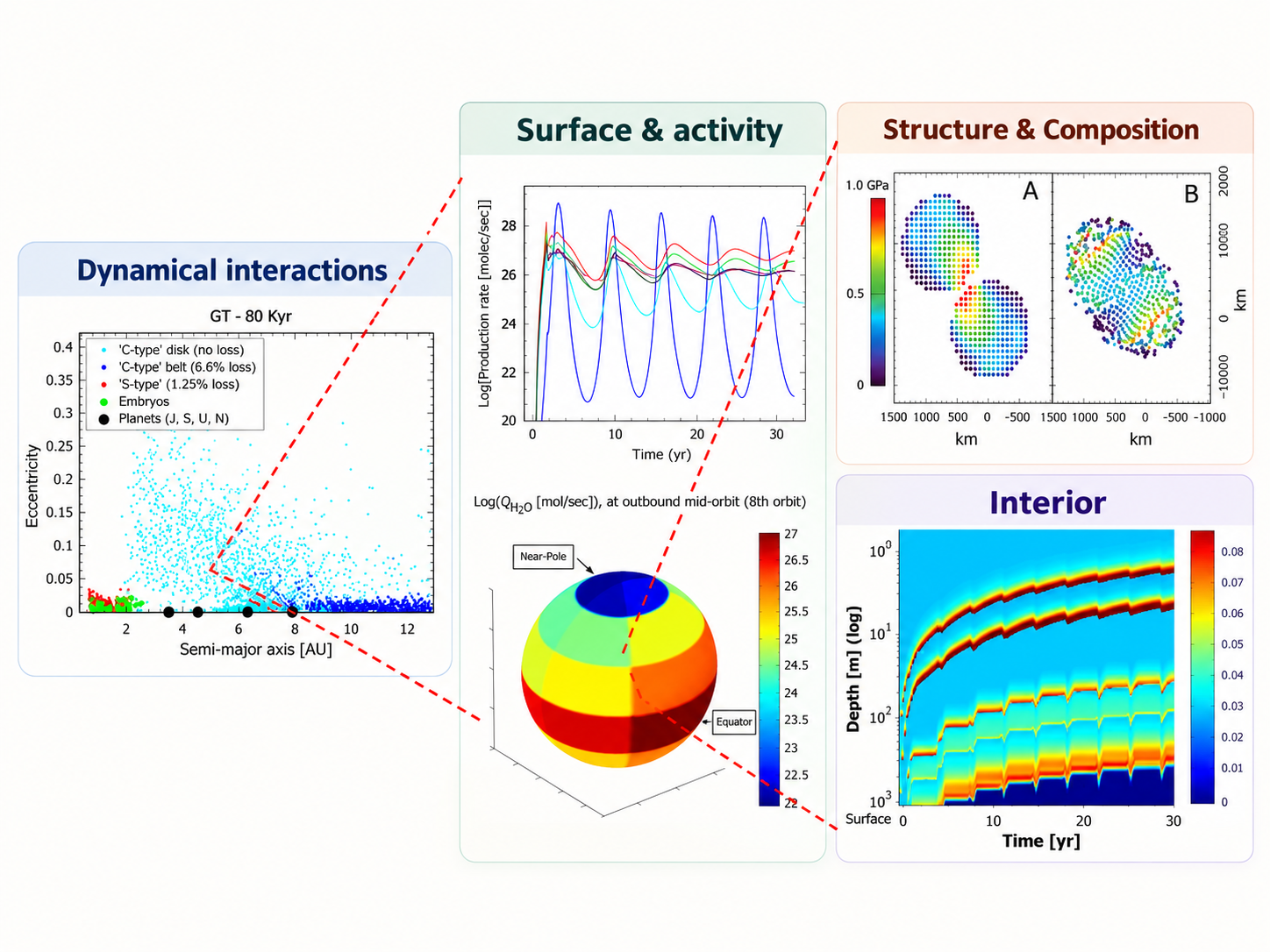
Much of my planetary work has involved the same sequence at different scales: establish the dynamical environment, work out the thermal and physical consequences, and ask what should be observable at the surface.
The figure pulls together examples from that line of work—orbital dynamics, activity, structure and composition, and interior evolution. They are separate calculations, not one giant model.